
How Is Cork Harvested in Portugal, and Does the Bark Grow Back?
In Portugal, skilled workers lift the outer bark from a living cork oak in planks. The tree stays rooted and grows a fresh layer of cork. A typical interval between harvests is nine years, and the bark from the first harvest has quite different uses from the bark that grows back.
When is a cork oak ready for its first harvest?
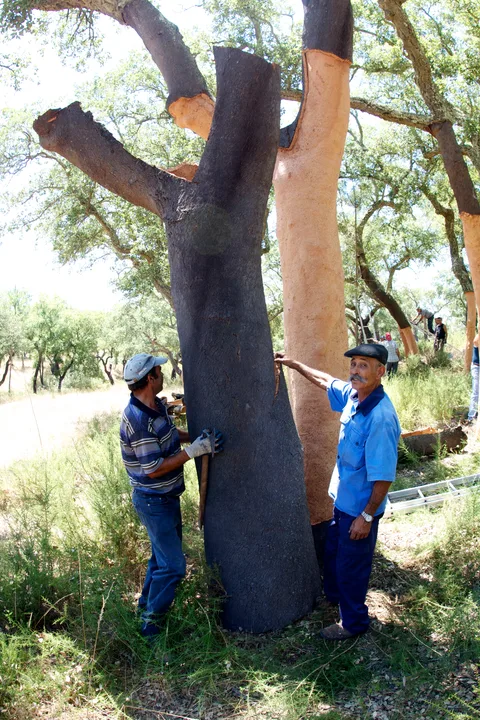
Cork is the outer bark of Quercus suber, the cork oak. The first harvest in Portugal normally comes when the tree is about 25 years old. The practical measure is the girth of the trunk. APCOR gives a minimum circumference of 70 cm measured 1.3 m above the ground. Two trees planted in the same year can reach that size at different times. APCOR’s account of the cork oak.
How does the bark come away from the tree?
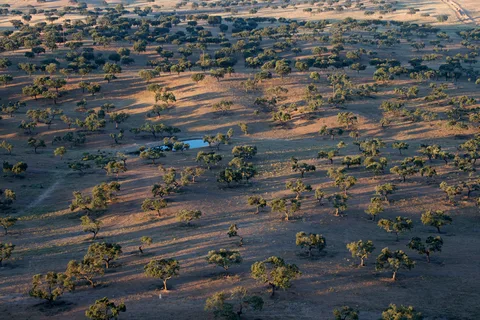
The work takes place in the warmer months when the bark separates readily. A skilled harvester, a descortiçador, opens it along a vertical fissure and marks where the top and bottom of the plank will be. The worker then loosens the curved section and lifts it away, preserving the living tissue beneath. The photograph from the Alentejo on page 9 of the book catches the moment when a tall strip has separated from much of the trunk. The crown is still in leaf above it. APCOR’s illustrated harvest sequence.
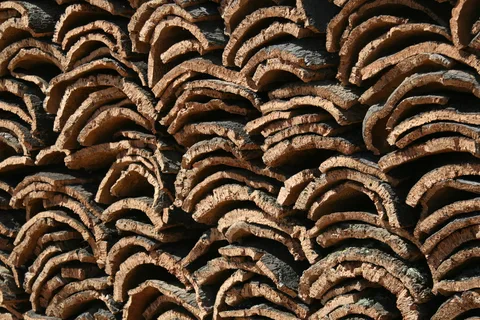
Once the plank comes free, it still carries the arc of the trunk. Stacked end-on, those arcs leave narrow pockets of daylight between pieces. A board made by pressing granules begins its life as a sheet or a block of a chosen size. A freshly stripped plank already has a shape dictated by an individual tree.
Does cork bark grow back, and how often?
After stripping, the tree produces another layer of cork under the exposed surface. Allowing time for that layer to thicken is what makes a second harvest possible. Portugal’s usual nine-year cycle refers to successive harvests of a mature tree. It runs on a different clock from the roughly quarter-century wait before the first harvest. Harvesters mark the trunk with the final digit of the harvest year so the cycle can be tracked in the field. APCOR on marking and regrowth.
Why do the first and later harvests have different uses?
The first stripping, known as desbóia, produces virgin cork with a deeply irregular structure. It can supply granules for products such as insulation. The second harvest yields more evenly formed secondary cork. From the third harvest onwards, the tree can produce amadia, the more regular reproduction cork from which high-quality one-piece stoppers can be cut. Individual planks still need to be selected for the job. APCOR’s descriptions of the three harvests.
One material route leads back to the furniture in the book. Cutting stoppers leaves cork between the holes. Those fragments can be ground and pressed into stock for much larger objects, including the turned pieces of Jasper Morrison’s Cork Family. In the forest the useful unit is a plank. In the workshop it can be a single grain. See the grain in Cork Family Model A. Follow the process from granules to furniture.